There's a creator right now filming a TikTok Shop video about a product they think is adorable. They love the packaging. They love the colors. They love the concept. They're going to get 47 views and zero sales, and they will not understand why.
Three accounts away, someone else is filming a video about an ugly portable stain remover. Nothing cute about it. Nothing aesthetic. Nothing Instagram-worthy. That video will generate $800 in commissions this week because the product solves a problem that makes parents feel frantic, embarrassed, and desperate — every single day.
The difference between these two creators is not talent, follower count, or algorithm luck. The difference is something most TikTok Shop affiliates never learn, something that separates the people who earn life-changing income from the people who post into the void until they quit.
The difference is pain.
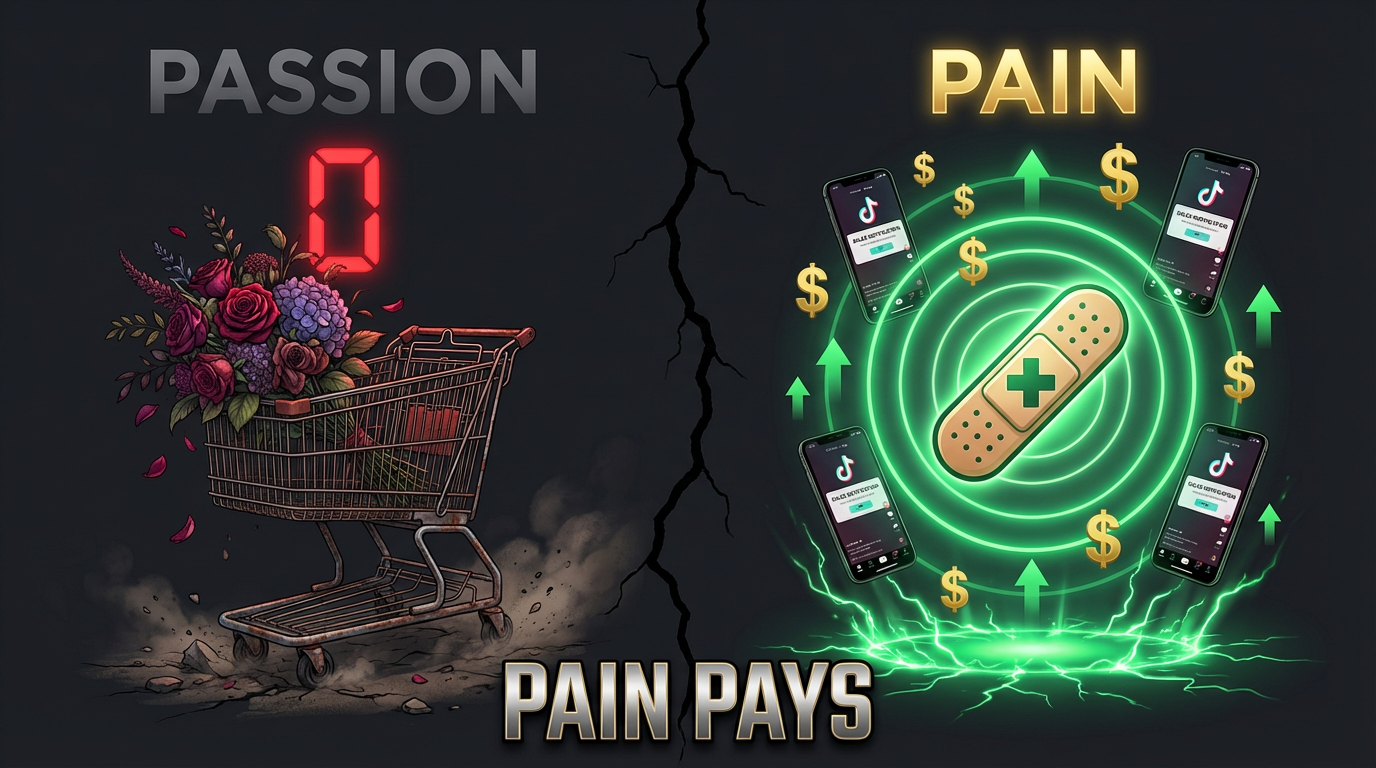
This is the core of a brutally honest framework called "Pain Pays, Passion Doesn't" that applies to every business ever built, and applies to TikTok Shop affiliate marketing with surgical precision. If you understand this framework, you will pick better products, write better hooks, create more compelling content, and earn more commissions than creators with ten times your following. If you ignore it, you'll keep wondering why videos about products you "love" never convert.
Let's break it down.
The Market Doesn't Care What You Love. It Pays For What Hurts.
Here's the uncomfortable truth that the Pain Pays framework forces you to confront: passion is internal, but money is external. You might be obsessed with a certain brand of aesthetic water bottles. You might genuinely love a particular line of decorative candles. You might think a certain gadget is the coolest thing you've ever seen. None of that matters to the person scrolling past your video at midnight.
The person scrolling isn't looking for things you love. They're trying to escape something that bothers them. Maybe it's the back pain that's been keeping them awake for three weeks. Maybe it's the stain on their car seat that makes them feel embarrassed every time they give someone a ride. Maybe it's the kitchen drawer that explodes every time they open it and wastes five minutes of their morning looking for the right utensil.
Here's the truth: "When someone reaches into their wallet, they are not celebrating your innovation or rewarding your hard work. They are trying to escape something that bothers them right now."
On TikTok Shop, this principle is amplified to an extreme degree. You have roughly three seconds to stop someone from scrolling. Three seconds to reach into their brain and trigger a response powerful enough to freeze their thumb. Cute products don't do that. Pain does. A person who sees a product that addresses something they've been silently frustrated about for weeks will stop, watch, and buy — often within the same 45-second video.
This is why 71% of TikTok Shop purchases happen spontaneously. Not because buyers are impulsive by nature, but because the right product, presented against the right pain point, collapses the entire decision-making process into a single moment of recognition: "That's exactly what I need."
The Five Emotional Drivers: Your Product Selection Cheat Code
The Pain Pays framework identifies five core motivations behind virtually every purchase ever made. These aren't abstract marketing theories — they're the operating system of human buying behavior, and they work as a direct filter for choosing which TikTok Shop products to promote.
Pain Relief is the most powerful driver because pain demands immediate attention. Products that remove something unpleasant — physical discomfort, daily frustration, recurring annoyance — trigger the fastest purchasing decisions. On TikTok Shop, this is the $14 neck massager that outsells the $60 aesthetic diffuser ten to one. The person with neck pain doesn't need convincing. They need relief. Your video just needs to show them the product working, and their wallet opens.
Time Savings ranks second because modern life makes everyone feel behind. Products that give people their time back — meal prep containers that cut cooking time in half, organizing systems that eliminate daily searching, cleaning tools that turn a 30-minute job into a five-minute job — sell because they promise the most valuable thing in the world: more time. When your TikTok hook says "This saves me 20 minutes every morning," you're not selling a product. You're selling a piece of someone's life back.
Money Protection comes next because financial anxiety is universal. Products that help people save money, avoid waste, or get more value from what they already spend generate strong emotional responses. This is why reusable products, money-saving alternatives to expensive brands, and "dupe" culture thrive on TikTok Shop. The hook "This $12 product replaced the $60 one I was buying every month" works because it turns the product into a financial decision, not just a purchase.
Safety and Security drives purchases because humans are wired to worry about threats. Products that protect — phone cases, car safety accessories, home security items, personal safety tools — sell well because the cost of NOT buying feels dangerous. "What if I don't have this when I need it?" is a question the buyer's brain asks automatically, and the answer always favors buying.
Status is last but quietly powerful because humans care deeply about how they're perceived. Products that make people feel smart, ahead of the curve, or admired by their peers sell through identity signaling. This is why "TikTok made me buy it" products go viral — they're not just purchases, they're social currency. Owning the right product signals that you're plugged in, that you know things other people don't.
The affiliates earning the biggest commissions on TikTok Shop aren't randomly picking trending products. They're filtering every product through these five drivers and asking one question: which pain does this solve, and how badly does it hurt?
The Pain Test: Four Questions That Predict Whether a Product Will Sell
The Pain Pays framework provides a brutal evaluation system that works for any business idea — and it works perfectly as a product selection filter for TikTok Shop affiliates. Before you request a free sample, before you film a single video, run every product through these four questions.
Question One: Does the buyer already know they have this problem?
If you have to convince someone they have the problem your product solves, the product will not sell on TikTok Shop. Period. You have three seconds in a hook. You cannot educate someone about a problem they didn't know existed and then sell them a solution in 45 seconds. That's not how the platform works.
The winning products solve problems people are already losing sleep over. They already know their feet hurt at work. They already know their shower grout looks disgusting. They already know they waste 20 minutes every morning looking for matching socks. The moment they see a product that addresses this known pain, recognition fires instantly and the scroll stops.
Products that require education — supplements with unfamiliar ingredients, gadgets that solve problems people haven't identified yet, solutions looking for problems — are the products that get views but not sales. The reality is simple: teaching people that they should care about something is expensive and slow. Selling to people who already care is fast and profitable.
Question Two: Is the pain expensive enough to justify spending money?
Not all pain is created equal. A minor annoyance that costs nothing to ignore will not motivate a purchase. A problem that costs the buyer money, time, or emotional distress every single day it goes unsolved creates urgency that makes the price feel small.
This is the "cost of doing nothing" test. If ignoring the problem is more expensive than the product, the product sells itself. A $25 drain unclogger sells because the alternative is a $200 plumber visit. A $15 car phone mount sells because the alternative is a $300 texting-while-driving ticket. A $20 kitchen organizer sells because the alternative is wasting 10 minutes every day and showing up late to work.
The best TikTok Shop products exist in the sweet spot where the average order value — typically $20 to $50 — feels like a bargain compared to the ongoing cost of the unsolved problem.
Question Three: How are they solving it right now?
This question is gold for TikTok Shop affiliates, and almost nobody asks it. If someone already has the problem and they're already spending money on inferior solutions, you don't have to create demand — you just have to redirect it. The demand already exists. The money is already being spent. You just need to show that your product is the better option.
This is why comparison hooks are so powerful on TikTok Shop. "I was spending $40 a month on disposable cleaning pads until I found this $18 reusable one." "I tried three different back supports before this one actually worked." These hooks aren't just selling a product — they're intercepting an existing purchasing behavior and offering an upgrade.
If the answer to "how are they solving it now?" is "they're not doing anything," proceed with caution. If nobody is currently spending money to solve this problem, the pain often isn't strong enough to trigger purchasing. Proven demand means proven pain.
Question Four: Is there urgency — or will they "think about it later"?
"Later" is where TikTok Shop sales go to die. Every product you promote needs to solve a problem that feels urgent. Not urgent because you created artificial scarcity, but genuinely urgent because the problem is actively bothering the buyer right now.
Products with built-in urgency: the kid's birthday party is this weekend and they need decorations, their skin is breaking out before a big event, their kitchen is a disaster and guests are coming, their car smells bad and they have a date tonight. These problems have deadlines attached to them — not deadlines you manufactured, but deadlines that already exist in the buyer's life.
Products without urgency: things that would be "nice to have someday," products that improve something that's already functioning adequately, decorative items with no functional purpose. These products get saved to wishlists. Wishlist items don't pay commissions.
Reverse-Engineering Pain from the TikTok Shop Trending Page
Now that you have the framework, here's how to apply it in practice. Instead of browsing TikTok Shop's trending products and asking "What do I think looks cool?" you browse the trending page and ask a completely different set of questions.
Start with the "Top Selling" tab and look at what's actually moving volume. Ignore your personal taste entirely. For every product in the top 50, ask: what pain does this solve? Why would someone need this badly enough to buy it from a 30-second video? What would happen in this person's life if they didn't buy this?
You'll notice a pattern immediately. The top sellers aren't the prettiest products or the most innovative ones. They're the ones that solve the most obvious, most relatable, most emotionally charged problems. Posture correctors outsell aesthetic desk accessories. Stain removers outsell decorative organizers. Pain relief patches outsell wellness supplements. The market votes with its wallet, and it always votes for pain relief over pleasure.
Next, go to the comments section of viral TikTok Shop videos. This is the richest pain-point research you'll ever do, and it's completely free. When a product video goes viral, the comments section fills with people describing their experience with the problem. "I've been dealing with this for YEARS." "Where was this when I ruined my favorite shirt last week?" "My husband needs this SO bad." These are people verbalizing their pain in their own words — words you can then use in your hooks and scripts.
This is the practice of "listening for problems that involve money, time, stress, embarrassment, or risk." On TikTok, the comments section is the listening session, and it's running 24 hours a day.
Why "Interesting" Products Fail and "Boring" Products Print Money
Here's where the Pain Pays framework delivers its most counterintuitive insight for TikTok Shop affiliates: the products that seem most exciting to promote are often the worst performers, and the products that seem boring are often the biggest earners.
A novelty gadget gets attention. Attention is not demand. People will watch a video about a cool-looking desk toy, comment "that's so cool," share it with friends, and never buy it. The product is interesting, but it doesn't solve a pain that justifies spending money. Remember: people will click, comment, like, and share things that are fun or clever, but real demand only shows up when someone pulls out a credit card without needing to be convinced.
Meanwhile, a $16 silicone sink strainer isn't going viral on anyone's mood board. Nobody's pinning it to their aesthetic inspiration folder. But it solves a problem that every person with a kitchen drain experiences multiple times per week — the disgusting clog of food debris that makes the sink smell and requires gross manual cleaning. The person who sees this product in a TikTok video doesn't think "that's cool." They think "I need that." And "I need that" is the sentence that generates commissions.
This doesn't mean you should only promote ugly products. It means your product selection process should start with pain and work backward to aesthetics, not the other way around. Find the pain first. Then find the product that solves it. Then figure out how to make the video visually compelling. The pain is the foundation. Everything else is decoration.
Applying the Framework to Your Content, Not Just Your Product Selection
The Pain Pays framework doesn't just change which products you promote. It transforms how you create content about them. When you understand that every purchase is driven by emotional pain, your hooks, scripts, and calls to action all shift from feature-focused to pain-focused.
A feature-focused hook says: "This kitchen organizer has 12 compartments and fits any standard drawer."
A pain-focused hook says: "I used to waste 10 minutes every morning digging through a junk drawer looking for the ONE thing I needed."
The feature hook describes the product. The pain hook describes the buyer's life. And on TikTok, where the viewer is the main character of every video they watch, describing their life is infinitely more compelling than describing your product.
This framework for crafting offers applies directly to TikTok Shop scripts: your offer must answer one question clearly — what will be better after I buy this? Every TikTok Shop video you create should answer that question within the first 10 seconds. Not what the product is. Not how it works. What will be different in the viewer's daily experience after they own it.
"You'll never have to scrub grout on your hands and knees again." "You'll actually leave the house on time instead of looking for your keys." "You'll stop waking up with neck pain every single morning."
These are promises of pain relief. And pain relief is what opens wallets.
The Uncomfortable Truth Most Affiliates Never Accept
The Pain Pays framework comes with a message that most aspiring TikTok Shop affiliates don't want to hear: if your videos aren't converting, the market is telling you something. Not about your editing skills, not about the algorithm, not about your follower count. It's telling you that the product you're promoting doesn't solve a problem that hurts enough to trigger spending.
Here's the reality: if people are not buying, they are telling you your solution is not valuable enough to them right now — and this feedback is more accurate than surveys, focus groups, or conversations with friends and family. The market votes with money, not with opinions.
The creators who earn consistently on TikTok Shop have internalized this. When a product doesn't convert, they don't blame the algorithm. They don't tweak the video six times hoping for different results. They move on to a product that addresses a more painful problem. They let the market's silence guide them toward the products the market actually wants to buy.
This is the mindset shift that turns TikTok Shop affiliate marketing from a lottery into a system. You stop guessing which products will sell based on what looks good or what's trending in your niche. You start testing products based on the severity of the pain they address, the urgency of the buyer's situation, and the clarity of the outcome you can promise in a 45-second video.
The System That Makes Pain Profitable at Scale
Understanding pain is the strategy. But executing on that understanding — consistently, at volume, across dozens of products and hundreds of videos — is where most creators hit a wall. You can identify the perfect pain-point product. You can craft the perfect pain-focused hook. But doing that two to three times per day, every day, while testing new products and iterating on what works? That's where the business either scales or stalls.
ViralAdsNow exists to turn the Pain Pays framework into a content machine.
Our AI-powered platform doesn't just help you make videos faster. It helps you make smarter videos — videos built around the pain points that actually drive purchases, with hooks engineered to trigger recognition, scripts structured around emotional outcomes instead of features, and visual sequences designed to demonstrate the "before and after" of pain relief.
You bring the product selection intelligence. You identify the pain. You understand why the buyer needs this product badly enough to buy it from a 30-second video. ViralAdsNow handles the rest — generating the scroll-stopping content that turns that pain into commissions, at the volume the TikTok Shop algorithm demands.
The market pays for pain. Not passion, not creativity, not good intentions. Pain. The affiliates who understand this earn more than the ones who don't, and it's not even close.
Subscribe to ViralAdsNow today and start building your TikTok Shop content around the only thing that has ever made people buy: the urgent, undeniable need to make something painful go away.
Pain is the product. Relief is the sale. Visit ViralAdsNow.com and start creating content that sells what the market is actually buying.