
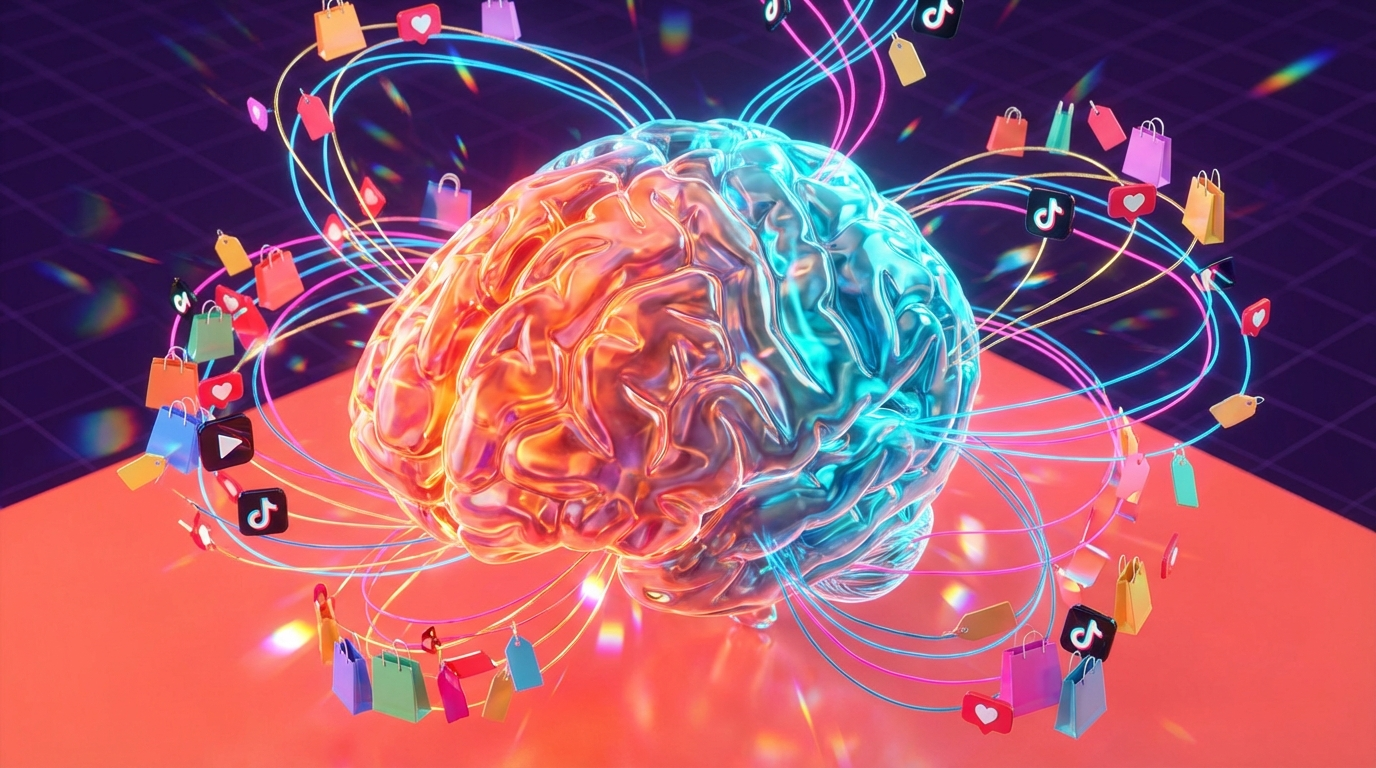
Here's a number that should reshape how you think about every TikTok Shop video you create: 71% of TikTok shoppers buy something because they stumbled across it in their feed — not because they were looking for it. They weren't searching. They weren't comparison shopping. They weren't even thinking about buying. They were scrolling for entertainment, and something in a 30-second video reached into their brain and flipped a switch from "just watching" to "I need this."
That switch isn't random. It's not luck. And it's definitely not just about having a good product.
It's psychology.
One in two TikTok users has spent at least $100 on impulse purchases driven by creator content in the past year. Gen Z consumers are 34% more likely to buy from an influencer recommendation than from a traditional ad. And academic research has now confirmed what top affiliates have known intuitively: heightened emotional arousal directly diminishes self-control, which is exactly what fosters impulsive purchasing.
TikTok Shop isn't just an e-commerce platform. It's a psychological environment — one where the architecture of the feed, the format of the content, and the behavior of the audience all conspire to create the most impulse-friendly shopping experience ever designed. The affiliates earning life-changing commissions aren't just good at making videos. They understand how buying decisions actually happen in the human brain, and they engineer their content to trigger those decisions.
Here are the seven psychological principles driving TikTok Shop sales — and how you can ethically deploy each one in your content.
1. The Curiosity Gap: The Itch Your Brain Can't Ignore
The curiosity gap is the space between what someone knows and what they want to know. When a TikTok video opens with "Nobody is talking about this $12 product that replaced my entire skincare routine," your brain registers an information imbalance. You know there's a product. You don't know what it is. And until that gap is closed, you feel a low-grade psychological discomfort that can only be relieved by continuing to watch.
This isn't metaphorical. Neuroscience research has shown that information gaps activate the same reward circuits as physical hunger. Your brain literally craves the missing information the way it craves food. And on TikTok, where the next video is one flick away, the curiosity gap is the only thing standing between your content and oblivion.
The top TikTok Shop affiliates don't just create curiosity gaps — they stack them. The hook opens a gap ("You've been washing your face wrong"). The middle of the video opens another ("But that's not even the worst part"). The product reveal closes the first gap while opening a final one ("And right now it's 40% off, but I don't know how long that'll last"). Each gap propels the viewer deeper into the video, and by the time they reach the product link, they've been psychologically primed through multiple cycles of tension and relief.
For your content: never reveal the product in the first three seconds. The gap between the problem and the solution is where all the psychological power lives.
2. Social Proof: The Invisible Crowd Telling You to Buy
Humans are herd animals wearing business casual. When we see other people doing something — buying a product, praising a brand, standing in line — our brain uses that as a shortcut: "If everyone else thinks this is good, it probably is."
TikTok is the most powerful social proof engine ever built. The platform's entire culture is built on trends, where a single product can go from unknown to sold-out in 48 hours because enough creators made videos about it. The hashtag #TikTokMadeMeBuyIt isn't just a marketing phenomenon — it's social proof operating at internet scale.
The research is clear on this. Studies on TikTok purchasing behavior found that social influence is one of the primary drivers of impulse buying on the platform. When a viewer sees that a product has thousands of comments, that other creators are promoting it, that it's "trending" on TikTok Shop — each of these signals reduces the perceived risk of purchasing. The internal monologue shifts from "Is this worth it?" to "Everyone else already has this."
Smart affiliates weaponize social proof in their content without being heavy-handed about it. They reference view counts ("This video about this product got 2 million views, so I had to try it"). They show comment screenshots ("Everyone kept asking me about this, so here's my honest review"). They use trending sounds associated with popular products, which creates an ambient layer of social validation. The viewer doesn't consciously process "other people approve of this product" — they just feel it.
3. FOMO: The Fear That Sells Faster Than Any Discount
The Fear Of Missing Out isn't just a social media buzzword — it's a clinically documented psychological phenomenon that researchers have directly linked to impulse purchasing behavior on TikTok. A 2025 study published in the European Journal of Business and Management Research found that FOMO significantly drives impulse buying during TikTok live streams and video shopping, particularly among young consumers.
FOMO works because humans are more motivated by the fear of losing something than the prospect of gaining something of equal value. This is loss aversion, one of the most well-established findings in behavioral economics. When a TikTok Shop video says "Only 47 left in stock" or "This deal ends at midnight," the viewer's brain doesn't process a shopping opportunity — it processes a potential loss. And losses demand immediate action.
The most effective FOMO triggers on TikTok Shop are temporal (limited-time deals), quantity-based (low stock warnings), and social (everyone else is buying this before you). But the affiliates who earn the most combine FOMO with the curiosity gap to create what we call "compound urgency." The video opens with curiosity ("I found something insane on TikTok Shop"), builds desire through demonstration, and closes with scarcity ("I literally just checked and there are only a few hundred left at this price"). The viewer has been pulled through curiosity, validated by product demonstration, and then pushed to act by the fear of missing out. It's a complete psychological sales funnel compressed into 45 seconds.
4. The Parasocial Trust Shortcut
Here's something counterintuitive: TikTok users trust creator recommendations more than celebrity endorsements. Gen Z is 50% more likely to buy based on an influencer recommendation than a celebrity endorsement. Why? Because of a psychological phenomenon called parasocial interaction — the one-sided relationship viewers form with creators they watch regularly.
When someone watches your content repeatedly, their brain begins processing you as a familiar acquaintance, even though you've never met. This is the same psychological mechanism that makes you feel like you "know" your favorite podcast host or YouTuber. And with familiarity comes trust. Research on TikTok live commerce found that trust — specifically trust built through perceived authenticity and interaction — is one of the most powerful predictors of impulse buying behavior.
This is why micro-influencers with fewer than 50,000 followers have a 30.1% engagement rate on TikTok affiliate content, dwarfing larger creators. Smaller audiences feel more personal. The parasocial bond is stronger. And when that trusted "friend" recommends a product, the recommendation carries the psychological weight of a personal endorsement, not an advertisement.
For faceless creators, this trust still builds — just differently. Consistency of voice, niche expertise, and genuine product interaction all contribute to parasocial familiarity even without a visible face. A viewer who watches twenty videos from the same faceless skincare account starts to trust that "person" the same way they'd trust a friend who happens to know a lot about skincare.
5. The Dopamine Loop: Entertainment as a Gateway Drug to Purchasing
TikTok's feed is designed to deliver variable rewards — an unpredictable stream of content that might be funny, surprising, informative, or emotionally moving. This unpredictability is the same mechanism that makes slot machines addictive. Each swipe is a pull of the lever, and the brain releases dopamine not when a reward arrives, but in anticipation of a potential reward.
This matters enormously for TikTok Shop because the shopping experience is embedded inside the dopamine loop, not separate from it. On traditional e-commerce platforms, shopping is a deliberate activity — you go to Amazon, you search for a product, you compare options. On TikTok, shopping is woven into the entertainment experience. You're watching funny videos, you see a product that looks cool, and buying it is a one-tap extension of the entertainment you were already enjoying.
Academic research on TikTok shopping behavior has confirmed this using what psychologists call "flow theory" — the state of being so absorbed in an activity that you lose track of time and external concerns. When viewers enter a flow state while scrolling TikTok, their critical evaluation of purchasing decisions decreases. They're not in "shopping mode" with their guard up. They're in "entertainment mode" with their guard down. And that's exactly when a well-crafted product video converts.
The practical implication is enormous: your TikTok Shop content must be entertaining first and commercial second. The moment a viewer's brain categorizes your video as "an ad," they exit the flow state and re-engage their critical faculties. But if your product video feels like just another piece of entertaining content in their feed — one that happens to feature something they want — the purchase feels less like a transaction and more like a natural extension of their scrolling experience.
6. The Anchoring Effect: Why "Before" Prices Make Everything Feel Like a Steal
When a TikTok Shop video shows a product and says "This is normally $89 on Amazon, but right now it's $34 on TikTok Shop," something fascinating happens in the viewer's brain. The $89 figure becomes an anchor — a reference point against which the actual price is evaluated. Even if the viewer has no idea what the product "should" cost, that first number permanently warps their perception of value.
Anchoring is one of the most robust findings in behavioral economics. It works even when people know it's being used on them. And on TikTok Shop, where the average order is between $20 and $50, anchoring transforms modestly priced products into perceived bargains.
The best affiliates use anchoring naturally and honestly. They compare TikTok Shop prices to Amazon listings (TikTok Shop frequently undercuts Amazon on trending products). They reference the cost of alternatives ("I used to spend $60 a month on this — this $22 product does the same thing"). They stack the value ("For less than the price of a coffee, you get 90 servings"). Each comparison creates a new anchor that makes the actual price feel increasingly reasonable.
What's psychologically powerful about anchoring on TikTok Shop specifically is that the price comparison feels organic rather than salesy. Unlike a traditional ad that leads with "50% OFF," a creator casually mentioning "I couldn't believe this was only $29" feels like genuine surprise — which triggers the viewer's own surprise and the perception of a deal worth acting on.
7. Identity Signaling: "This Is Who I Am" Purchases
The deepest psychological driver of TikTok Shop purchases isn't rational at all. It's identity. When someone buys a minimalist water bottle, a specific skincare brand, or a particular style of home organizer, they're not just buying a product — they're buying a signal of who they are and who they want to be.
Research on social commerce confirms this: symbolic value — the extent to which a product helps consumers express their identity — is a significant driver of engagement and impulse buying. On TikTok, where aesthetics and lifestyle aspirations define entire subcultures (CleanTok, BookTok, GymTok, CottageCore), products serve as tribal markers. Buying the "right" water bottle isn't about hydration. It's about belonging.
The affiliates who understand this don't sell products. They sell identities. They don't say "this organizer holds a lot of stuff." They show a beautifully organized pantry and let the viewer feel the aspiration. They don't say "this supplement has good ingredients." They show a morning routine that radiates wellness and discipline. The product is the vehicle. The identity is the destination.
This is why niching down works so well psychologically. When your account consistently represents a specific identity — the clean skincare enthusiast, the minimalist home organizer, the fitness-obsessed meal prepper — your product recommendations carry the weight of identity validation. The viewer isn't just buying a product you recommended. They're affirming their membership in the tribe your content represents.
Putting Psychology to Work (Without Manipulation)
There's an important ethical line in all of this. Understanding buying psychology doesn't mean exploiting it. The affiliates building sustainable, long-term businesses on TikTok Shop use these principles to connect genuinely good products with people who will genuinely benefit from them. They create honest content. They promote products they've actually used. They don't fabricate scarcity or make misleading claims.
The psychology works best when it's aligned with real value. A genuine curiosity gap ("I was skeptical about this, but here's what happened") converts better than manufactured clickbait. Real social proof (actual comments, actual results) outperforms fake urgency. And authentic identity alignment — promoting products that genuinely fit your niche and audience — builds the parasocial trust that compounds over time into a reliable income stream.
The challenge isn't understanding the psychology. It's applying it consistently across hundreds of pieces of content, each one engineered to trigger the right responses while maintaining the authenticity that makes TikTok Shop work in the first place.
That's the challenge ViralAdsNow was built to solve.
ViralAdsNow doesn't just help you produce TikTok Shop content faster — it helps you produce psychologically smarter content. Our AI-powered platform generates video ads built on the same triggers top affiliates use: curiosity-gap hooks, social-proof framing, urgency-driven CTAs, and entertainment-first structures that keep viewers in the flow state where buying decisions happen naturally. Every script, every visual sequence, every hook is informed by what actually makes people buy — not what looks good in a marketing textbook.
The psychology of selling on TikTok Shop isn't a secret. But the ability to apply it at scale, across dozens of videos per week, with consistency and quality? That's a competitive advantage most creators don't have.
Subscribe to ViralAdsNow today and start creating content that doesn't just catch attention — it captures the buying brain.
Your audience is already primed to buy. Give them the right trigger. Visit ViralAdsNow.com and let psychology do the selling.